
English

English
English
English
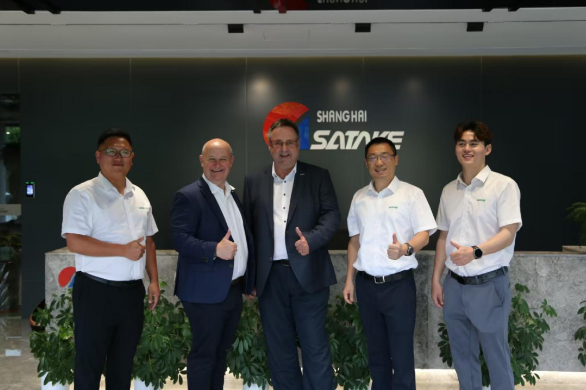
Celebrating the National Day Golden Week by revisiting a defining moment in our strategic cooperation!
For the flagship BYD project featuring 3 advanced climatic wind tunnels and 1 aeroacoustic wind tunnel, we joined forces with Werum Software & Systems AG. While Werum supplies the industry-leading control software architecture, Satake takes full responsibility for custom climatic wind tunnel manufacturing, complex on-site integration, and long-term local maintenance.
Driven by our core spirit to embrace challenges, the Satake team delivers tailored, end-to-end solutions that master complex climatic simulations, high-precision flow control, and seamless system integration.
We take immense pride in supporting the rapid rise and global success of China’s automotive industry. Looking ahead, we will continue breaking technological boundaries to power the future of mobility!
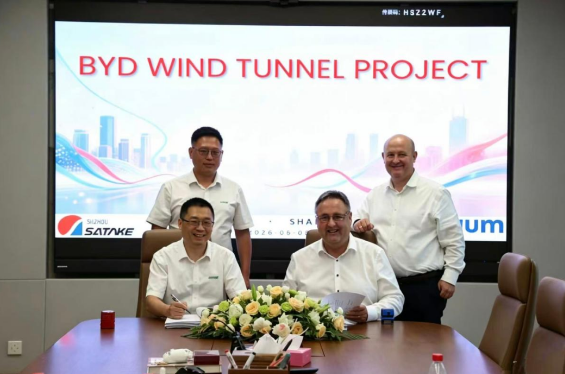
The BYD project includes three climatic wind tunnels and one aeroacoustic wind tunnel, forming an integrated testing environment for advanced vehicle research, validation, and development.
Modern vehicle development requires engineers to evaluate performance under repeatable and precisely controlled conditions rather than relying only on outdoor road testing. An automotive wind tunnel facility makes it possible to reproduce different environmental and airflow conditions within a controlled laboratory environment, helping engineering teams conduct consistent tests throughout the vehicle development cycle.
Satake provides customized Wind Tunnel solutions for automotive manufacturers, research institutes, and testing organizations. Depending on the testing purpose, wind tunnel systems can support environmental simulation, vehicle thermal management evaluation, aerodynamic development, airflow analysis, and acoustic testing.
For BYD, the combination of climatic and aeroacoustic wind tunnels provides different but complementary testing capabilities, allowing vehicle development teams to evaluate performance from multiple engineering perspectives within dedicated test environments.
The three climatic wind tunnels in the project are designed to create controlled environmental conditions for vehicle testing.
An Automotive Climatic Wind Tunnel can simulate different climatic and road-related conditions, including temperature, humidity, wind speed, road load, rain, and snow. These parameters can be controlled individually or combined according to specific test requirements.
Compared with road testing that may depend on location, season, and natural weather conditions, climatic wind tunnel testing provides engineers with a more repeatable environment. This is particularly useful when vehicle manufacturers need to reproduce extreme or specific environmental conditions during different stages of development.
For new energy vehicles, controlled environmental testing is also increasingly important for evaluating vehicle performance under different thermal and climatic conditions. Satake's automotive environmental simulation capabilities support the testing requirements associated with new energy vehicle development, including whole-vehicle and key-system validation.
The role of the climatic wind tunnels in this project therefore extends beyond simply generating airflow. They provide a controlled engineering environment in which vehicle operating conditions and external climate conditions can be reproduced according to the requirements of the development program.
Alongside the climatic wind tunnels, the project also includes an aeroacoustic wind tunnel dedicated to aerodynamic and acoustic research.
Vehicle airflow affects not only aerodynamic efficiency but also wind noise, driving comfort, stability, and overall vehicle refinement. During the R&D phase, engineers need reliable facilities to observe airflow behavior and identify areas where aerodynamic performance or noise characteristics can be improved.
Satake's Aerodynamic-Acoustic Wind Tunnel is designed for vehicle and component testing related to airflow losses, airflow disturbances, aerodynamic performance, and noise generation.
For vehicle manufacturers developing increasingly efficient and refined vehicles, aerodynamic and acoustic optimization can become an important part of the overall engineering process. A dedicated aeroacoustic testing environment allows these characteristics to be investigated under controlled airflow conditions before the vehicle enters later stages of development or production.
By combining climatic simulation with aeroacoustic testing capabilities, the BYD project creates a broader testing infrastructure capable of supporting multiple vehicle engineering requirements.
A large-scale automotive wind tunnel project involves significantly more than supplying individual pieces of testing equipment.
Airflow systems, environmental control equipment, dynamometer systems, instrumentation, electrical systems, control software, safety systems, and supporting infrastructure need to operate together as one coordinated test facility. The engineering quality of system integration directly affects the reliability, repeatability, and long-term operation of the laboratory.
In the BYD project, Satake works together with Werum Software & Systems AG to support the implementation of the complete testing solution. Werum provides the wind tunnel control software architecture, while Satake undertakes customized equipment manufacturing, engineering coordination, complex on-site integration, and long-term local technical support.
This cooperation combines specialized control software with Satake's experience in environmental simulation equipment and wind tunnel engineering.
From equipment manufacturing and system integration to installation coordination and technical service, Satake supports the practical implementation of the testing facility rather than functioning only as an individual equipment supplier.
Automotive testing facilities are long-term engineering assets. Their value depends not only on initial system performance but also on reliable commissioning, stable operation, technical maintenance, and effective support throughout the facility lifecycle.
Satake's participation in the BYD automotive wind tunnel project reflects this full-project approach.
By combining customized manufacturing, environmental simulation technology, wind tunnel engineering, on-site integration, and localized technical support, Satake can work with automotive manufacturers and technology partners on complex testing facilities designed around specific R&D requirements.
The BYD project is also a practical example of how Satake's engineering capabilities can be integrated into a large-scale automotive testing program involving multiple wind tunnel systems, specialized control technology, and long-term operational requirements.

Suzhou Satake Engineering Co., Ltd. (SSEC)
+86 135 8580 0444
+862158436640 ext. 618
+86 512 5288 6911
+86 135 8580 0444
No. 6, Malu Road, High-tech Industrial Development Zone, Changshu City, Jiangsu Province
